November 11, 2026
Article by Nick Wade
BOISE, Idaho. – There is something different about Boise State men’s basketball this season, and it is
becoming increasingly difficult to ignore. The pace is faster, the ball is moving with greater purpose,
and the Broncos’ guards are attacking opposing defenses with a confidence that is beginning to
define this team.
Wednesday night’s 111–79 victory over Oakland was another demonstration of what new associate
head coach and offensive coordinator Will Voigt is building. Boise State improved to 3–0, reached
the 100–point mark for the third consecutive game for the first time in program history, and showed
that its new offensive identity is taking hold much faster than anyone could have reasonably
expected.
The final score suggests a comfortable evening, but Oakland made the Broncos work for it during
the first half. The Golden Grizzlies entered Boise at 0–4, but their early–season schedule had included
challenging matchups against Michigan, Stanford and Alabama. This was not a team that was going
to fold simply because it walked into ExtraMile Arena.
In fact, Oakland made Boise State uncomfortable for stretches, and the Broncos needed to respond
before turning the game into the decisive victory the final score reflects.
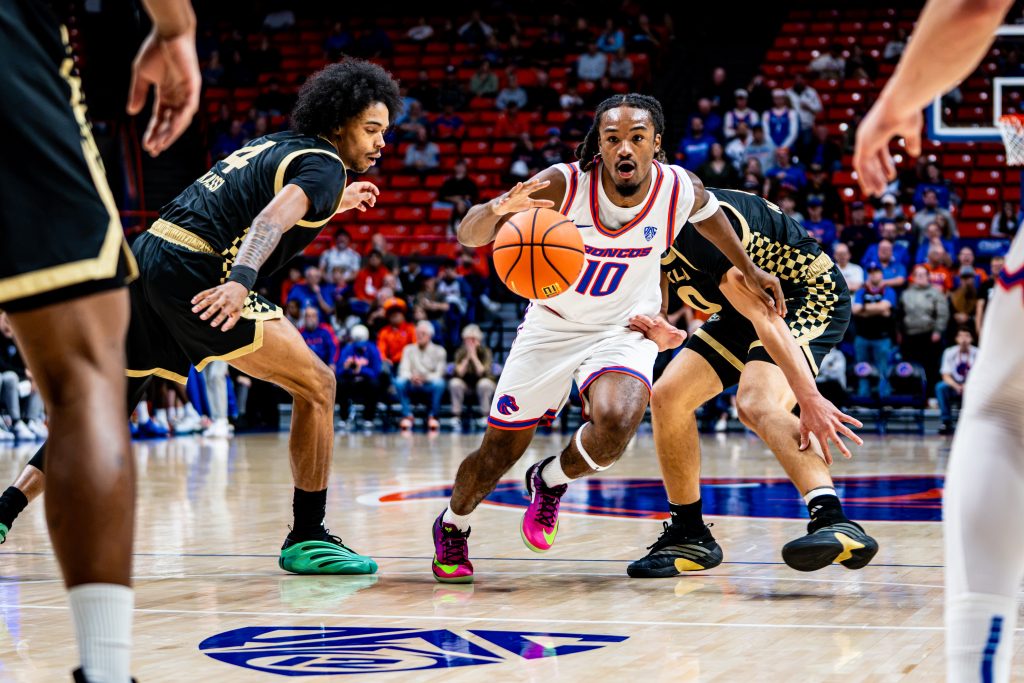
Spencer Ahrens set the tone early with the first Boise State basket, while Damari Wheeler–Thomas
immediately began attacking the defense. DWT was spectacular in the opening minutes, knocking
down perimeter shots, creating opportunities for teammates and pushing the tempo before Oakland
could establish its defensive positioning.
Wheeler–Thomas had nine points in the first four minutes and finished the first half with 18. His
ability to create offense without slowing down the possession is exactly what makes this version of
Boise State so dangerous. He can get downhill, find the open shooter, attack a mismatch or simply
take over a possession when the defense gives him an opportunity.
Pearson Carmichael brought the energy, finishing a fast–break opportunity created by Wheeler–
Thomas, while Dovydas Butka continued to establish himself as a force in the paint. Butka was
productive on both ends, finishing through contact offensively and protecting the basket defensively.
His presence gives the Broncos an important interior complement to a backcourt that is increasingly
difficult to contain.
difficult to contain.
Oakland refused to disappear, however. After Boise State built a nine–point advantage, the Golden
Grizzlies found their rhythm from beyond the arc and took advantage of a stretch when the Broncos
went cold. With just over five minutes remaining in the first half, Oakland had cut the margin to 36–
35.
That was a meaningful response from the visitors, but Boise State answered with the kind of
composure that championship–caliber teams need. Aginaldo “AG” Neto began finding his rhythm,
the defensive pressure tightened, and the Broncos closed the half on a 16–7 run to take a 52–42 lead
into the locker room.
The second half was where the difference in the two teams became unmistakable.
Boise State opened with better ball movement, sharper decisions and a renewed commitment to
attacking the basket. Butka helped establish the tone with contributions on both ends, Ahrens
delivered an emphatic dunk, and the Broncos began stretching the lead. A 13–2 run pushed the
margin to 20, and Oakland never seriously threatened again.
The numbers tell the story of a team playing connected basketball. Boise State shot 56.7 percent
from the field, made 14 three–pointers, recorded 23 assists and committed just six turnovers. The
Broncos scored 36 points off Oakland’s 23 turnovers and generated 20 fast–break points. They also
recorded eight steals and six blocked shots.
Neto led the way with 25 points, tying his career high while adding five assists and two steals. His
ability to control the game, create for himself and others, and attack in transition has been one of the
biggest developments of the early season.
Wheeler–Thomas finished with 23 points and six assists, shooting seven of 10 from the floor and four
of six from three–point range. Together, Neto and Wheeler–Thomas combined for 48 points and 11
assists. That is an outstanding night’s work from a backcourt that is quickly becoming one of the
most exciting in the conference, but most impressive was that they did not commit a single turnover
the whole game between the two of them.
Butka added 16 points and seven rebounds while making eight of his nine attempts. Ahrens and
Carmichael each contributed 11 points, giving Boise State five players in double figures. Jerquarius
“JQ” Stanback added nine points, five assists and two steals, continuing to provide energy and
defensive activity whenever he entered the game.
The most impressive part of the performance may be how quickly the players have adapted to
Voigt’s system.
Voigt arrived in Boise after serving on the BYU staff, bringing a philosophy built around pace,
spacing, ball movement and creating opportunities before opposing defenses can get organized. In
discussing the approach before the season, Voigt described it as “pace and space.” That description
is becoming more than a coaching phrase; it is becoming the identity of this basketball team.
spacing, ball movement and creating opportunities before opposing defenses can get organized. In
discussing the approach before the season, Voigt described it as “pace and space.” That description
is becoming more than a coaching phrase; it is becoming the identity of this basketball team.
Head coach Leon Rice has also emphasized that the new approach is personnel–driven. Speaking
after the Butler victory, Rice pointed to the ability of Neto and Wheeler–Thomas to create advantages
off the dribble and the shooting talent surrounding them. The system is designed to put those
strengths to work, and the early results suggest the players understand what is being asked of them.
After Wednesday’s game, we had an opportunity to speak with Oakland head coach Greg Kampe
following the postgame press conference. Having just faced Michigan and Alabama earlier in the
season, Kampe offered a meaningful evaluation of Boise State’s backcourt. He told us that Boise
State’s guards are just as good, if not better, than the guards he had seen from Michigan, Stanford,
and Alabama.
That is a significant compliment coming from a coach whose team has already faced that level of
competition. It also reinforces what Bronco Nation is beginning to see: Neto and Wheeler–Thomas
are not simply producing against lesser competition. Their combination of speed, skill, confidence
and decision–making gives Boise State a backcourt capable of competing with high–major programs.
There is still room for growth. Oakland scored 79 points, and its first–half shooting kept the game
competitive longer than Boise State would have preferred. The Broncos also have opportunities to
improve their perimeter consistency and continue developing defensive discipline. But the offensive
direction is encouraging, and the players appear increasingly comfortable with the freedom and
responsibility built into the system.
The larger significance of Wednesday’s victory is the consistency of production. Boise State has
scored 132, 100 and 111 points in its first three games, becoming the first team in program history to
open a season with three consecutive 100–point performances. The Broncos are 3–0 for the first time
since 2017–18 and are averaging more than 114 points per game. One of those resume-building
victories over a major program, Butler of the Big East.
Next comes a major early–season test against No. 25 Nebraska, the Broncos’ first road game of the
season. The environment will be different, the opponent will be more physically demanding, and
Boise State will have to prove that its new offensive identity travels.
For now, there is plenty to appreciate. Will Voigt has brought a refreshing approach, the guards have
embraced it, and the supporting cast is finding ways to contribute. The pace is unmistakably faster,
the ball is moving, and the Broncos are playing with an offensive confidence that has been missing in
recent seasons.
If Wednesday night is any indication, Boise State’s new offense is not just a promising experiment. It
is becoming a problem for opposing defenses.
is becoming a problem for opposing defenses.
#BleedBlue | #BoiseState | #BroncoNation